IELTS vs. TOEFL vs. Duolingo English Test: Which Exam Should You Take for Overseas Admissions?
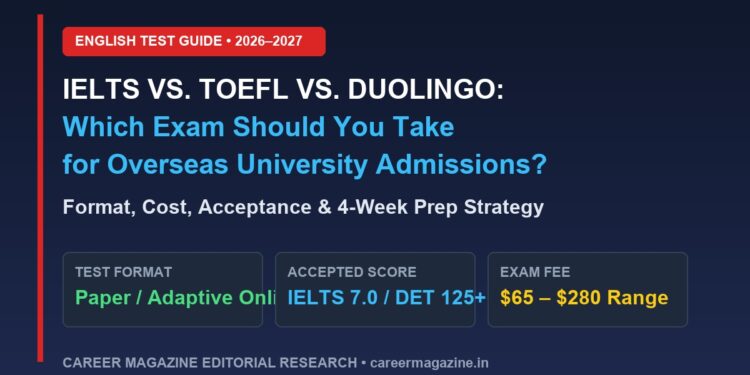
For Indian students aspiring to study abroad, demonstrating English language proficiency is a mandatory prerequisite for both university admission and visa clearance. With the landscape shifting rapidly—from traditional paper exams to computer-delivered testing and AI-proctored home tests—students are faced with a crucial decision: IELTS, TOEFL, or the Duolingo English Test (DET)?
Executive Snapshot: The Big 3 Exams
- IELTS (Academic): The global gold standard; universally accepted in the UK, Australia, Canada, New Zealand, and across Europe (accepted by 12,500+ institutions).
- TOEFL iBT: Heavily preferred across US research universities and Canadian postgraduate programs; renowned for academic campus-style listening and integrated speaking.
- Duolingo English Test (DET): The budget-friendly, ultra-convenient adaptive online exam ($65 vs ₹17,000+ for IELTS/TOEFL) accepted by 5,000+ universities including Yale, Columbia, and Imperial College London.
Exam Comparison: Format, Duration & Pricing
| Feature | IELTS Academic | TOEFL iBT | Duolingo English Test (DET) |
|---|---|---|---|
| Exam Delivery | Computer or Pen & Paper at test centers | Computer-based at center or home edition | 100% Online at home with AI & human proctoring |
| Test Duration | Approx. 2 hours 45 minutes | Under 2 hours (revised modern format) | Approx. 60 minutes |
| Approx. Fee (India) | ~₹17,000 – ₹17,500 | ~₹16,900 ($205) | ~$65 (~₹5,500) |
| Score Range | Band 0 – 9.0 | Score 0 – 120 | Score 10 – 160 |
| Results Turnaround | 3–5 days (computer) / 13 days (paper) | 4–6 calendar days | Within 48 hours |
| Score Retake Policy | IELTS One Skill Retake allowed | MyBest Scores super-score policy | Can test twice within a 30-day window |
Target Score Benchmarks by Country
- United Kingdom: Top Russell Group universities typically demand IELTS 6.5–7.0 (no sub-band below 6.0) or TOEFL 92–100. Always verify if the university accepts DET for CAS/visa issuance.
- United States: Ivy League and Tier-1 STEM programs prefer TOEFL 100+ or IELTS 7.5. Many prominent private universities now welcome Duolingo scores of 125–135+.
- Germany & Continental Europe: Public English-taught programs usually mandate IELTS 6.5 or TOEFL 85–90; DET acceptance is rising rapidly across business and engineering schools.
- Canada & Australia: High-demand student visa streams (such as SDS) standardly mandate IELTS Academic or PTE Academic. Always confirm immigration visa score compliance alongside university acceptance.
4-Week Score Maximization Strategy
Regardless of which exam you select, high scorers separate themselves through targeted test-format familiarity rather than passive vocabulary memorization:
- Week 1 (Diagnostic & Format Calibration): Take one timed diagnostic test under strict exam conditions to identify weakness between Listening, Reading, Writing, or Speaking.
- Week 2 (Writing Frameworks): Master standard academic argumentative structures. For IELTS Task 2 or TOEFL integrated essays, learn how to craft clear topic sentences backed by concrete empirical examples.
- Week 3 (Speaking Fluency & Natural Cadence): Practice speaking unscripted on varied prompts for 2 minutes without pausing or using filler words (“um”, “like”, “actually”). Record yourself and evaluate vocabulary precision.
- Week 4 (Full Mock Simulations): Execute at least 3 full-length timed mock tests at the exact time of your scheduled official exam.
Study Abroad & Scholarships Series Navigation
- Part 1: Study Abroad on a Budget: Top European Countries with Low Tuition
- Part 2: Top Full-Ride Scholarships for Indian Students: Chevening, DAAD & Erasmus Mundus
- Part 3: IELTS vs. TOEFL vs. Duolingo English Test: Detailed Benchmarks & Strategy (Current Article)
- Part 4: STEM Courses Abroad: Post-Study Work Visas & High-Paying Fields
- Part 5: Education Loans Without Collateral: How to Secure Up to ₹50 Lakh
- Part 6: Winning Statement of Purpose (SOP) & Letter of Recommendation Framework