Study Abroad on a Budget: Top European Countries with Zero or Low Tuition for Indian Students (2026–2027)
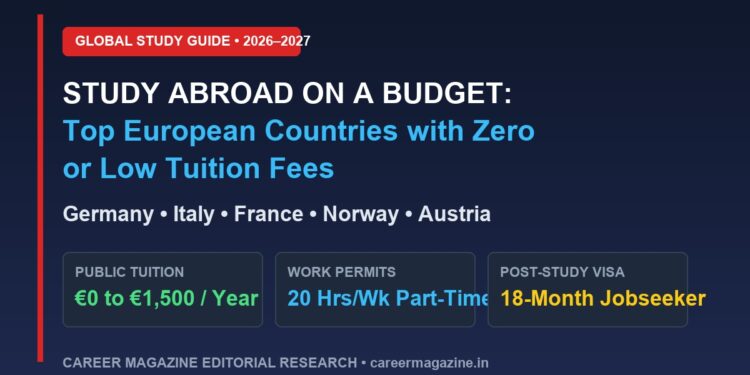
Studying overseas is widely perceived as an exclusive pathway reserved for families with deep pockets or students willing to shoulder crippling education loans. In traditional destinations like the United States, United Kingdom, Canada, and Australia, a standard two-year Master’s or four-year Bachelor’s degree frequently demands between ₹45 Lakh to ₹90 Lakh in tuition alone.
However, continental Europe operates on an entirely distinct educational philosophy: higher education is regarded as a public good funded predominantly by state taxation rather than private student debt. For Indian students willing to look past conventional Anglophone corridors, world-class public institutions across Germany, Italy, France, Austria, and Norway offer globally accredited degree programs taught 100% in English either completely tuition-free or at a modest administrative charge.
Executive Summary: Budget Study in Europe (2026–2027)
- Tuition-Free Hotspot: Public universities across 15 of Germany’s 16 federal states charge €0 tuition for all students regardless of nationality, requiring only a €150–€350 per semester solidarity transit fee.
- Need-Based Full Support: Italy’s regional DSU (Diritto allo Studio Universitario) scholarships provide zero tuition plus an annual living stipend of up to €7,000 based strictly on family income documentation (ISEE Parificato).
- Legally Authorized Work Rights: International students in Germany and France are legally permitted to work 20 hours per week (140 full days / 280 half days per year in Germany), comfortably earning €900 to €1,200 monthly to subsidize living expenses.
- Generous Post-Study Visas: Non-EU graduates secure an 18-month Jobseeker Residence Permit in Germany and up to 2 years in France/Ireland to transition directly into high-paying employment without employer sponsorship barriers.
1. Germany: The Global Benchmark for Tuition-Free Public Universities
Germany stands unmatched as the premier overseas destination for Indian STEM, engineering, computer science, and business scholars. Across 15 federal states, public universities—including elite TU9 research powerhouses like TU Munich, RWTH Aachen, TU Berlin, and Karlsruhe Institute of Technology (KIT)—charge zero tuition for undergraduate and postgraduate programs.
(Note: The state of Baden-Württemberg charges €1,500/semester for non-EU students, and Technical University of Munich recently introduced modular international fees for selected programs. However, hundreds of premier public universities across North Rhine-Westphalia, Bavaria, Hesse, Saxony, and Lower Saxony remain 100% free of tuition charges.)
Key Costs & The German Blocked Account (Sperrkonto)
While tuition is €0, the German government requires international applicants to prove financial self-sufficiency through a Blocked Account (Sperrkonto) deposited with approved providers (such as Expatrio, Coracle, or Fintiba). For the 2026 academic year, this amount is benchmarked at approximately €11,904/year (~₹10.8 Lakh), which is disbursed back to the student in equal monthly installments of €992 to cover accommodation, food, and mandatory health insurance.
Mandatory Requirement for Indians: Indian applicants must secure an APS Certificate (Akademische Prüfstelle) from the German Embassy in New Delhi prior to university application and visa processing. The verification validates your Indian degrees, transcripts, and language credentials.
2. Italy: DSU Scholarships & Low Public University Fees
Italy is rapidly emerging as South Europe’s top destination for Indian students in engineering, architecture, design, and economics. Institutions like Politecnico di Milano, University of Bologna, Sapienza University of Rome, and University of Padua provide exceptional English-taught degrees.
Standard tuition fees at Italian public universities are pegged directly to the student’s family economic indicator known as the ISEE Parificato (Equivalent Economic Situation Indicator). For families with modest household incomes, standard tuition is reduced to between €150 and €1,000 per year.
Furthermore, each region funds DSU Regional Scholarships (such as DSU Toscana, ER.GO in Emilia-Romagna, and LazioDisco). If awarded based on family economic standing:
- 100% Tuition Fee Waiver: The student pays nothing for tuition throughout their course duration.
- Free University Housing or Rent Subsidy: Access to student dormitories or cash rental assistance.
- Free Canteen Meals: Daily meal cards across campus cafeterias.
- Cash Living Stipend: An annual grant of €5,000 to €7,500 deposited directly into your bank account.
3. France: Subsidized Public Excellence & CAF Housing Support
France offers world-renowned academic rigor backed by significant state subsidies. While France introduced differentiated registration fees in public institutions (approx. €2,770/year for Bachelor’s and €3,770/year for Master’s), many public universities deliberately offer partial or total fee exemptions directly to admitted international students, reducing annual tuition back to the domestic rate of approximately €243 to €380 per year.
In addition, all international students in France are entitled to CAF (Caisse d’Allocations Familiales) housing subsidies. The French government reimburses between 25% to 40% of your monthly accommodation rent (saving ₹15,000 to ₹25,000 each month), significantly lowering real living costs in cities like Lyon, Toulouse, Grenoble, and Lille.
European Budget Study Destinations: Side-by-Side Comparison
| Country | Annual Tuition Range | Monthly Living Cost | Part-Time Work Limit | Post-Study Work Visa |
|---|---|---|---|---|
| Germany | €0 (Semester fee: €150–€350) | €850 – €1,050 | 20 hrs/week (140 full days) | 18-Month Jobseeker Permit |
| Italy | €150 – €1,200 (or €0 via DSU) | €650 – €850 | 20 hrs/week | 12-Month Permesso di Soggiorno |
| France | €243 – €3,770 (CAF subsidized) | €750 – €950 | 20 hrs/week (60% annual legal) | 2-Year Post-Study Visa (APS/RECE) |
| Austria | €1,500 / year (~€726/semester) | €850 – €1,000 | 20 hrs/week | 12-Month Jobseeker Permit |
| Poland | €1,500 – €3,000 / year | €450 – €600 | 20 hrs/week | 9-Month Post-Study Visa |
4. Actionable Steps: How Indian Students Can Apply for 2026–2027
To secure admission into these highly competitive public universities without relying on expensive education agents, follow this structured application timeline:
- Course Search: Utilize official national university portals like DAAD.de (Germany), Universitaly.it (Italy), and Campus France to filter for English-medium degree programs.
- Academic Documentation & APS: Ensure your GPA is converted accurately into the target grading scale. Candidates applying to Germany must initiate their APS verification at least 4 to 5 months in advance.
- Language Proficiency: While English programs require IELTS (6.5+) or TOEFL (90+), learning local A1/A2 German, Italian, or French dramatically increases your part-time employment prospects and day-to-day integration.
- Financial Architecture: Prepare documentation for the Blocked Account (Germany) or apostilled income tax returns and property assessments for the ISEE Parificato / DSU application (Italy) by May–June prior to the winter intake.
Explore the Study Abroad Master Series
This article is Part 1 of Career Magazine’s 6-part editorial guide to global education and financing:
- Part 1: Study Abroad on a Budget: Top European Countries with Low or Zero Tuition (Current Article)
- Part 2: Top Full-Ride Scholarships for Indian Students: Chevening, DAAD, Erasmus Mundus & Fulbright Guide
- Part 3: IELTS vs. TOEFL vs. Duolingo English Test: Detailed Benchmarks & Strategy
- Part 4: STEM Courses Abroad: High-Paying Fields & Post-Study Work Visas
- Part 5: Education Loans Without Collateral: How to Secure Up to ₹50 Lakh
- Part 6: Winning Statement of Purpose (SOP) & Recommendation Letter Blueprint