25th year of serving as the head of a Government… Modiji
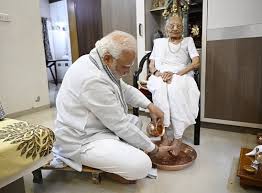
‘On this day in 2001, I took oath as Gujarat’s Chief Minister for the first time. Thanks to the continuous blessings of my fellow Indians, I am entering my 25th year of serving as the head of a Government. My gratitude to the people of India. Through all these years, it has been my constant endeavour to improve the lives of our people and contribute to the progress of this great nation that has nurtured us all.
Modiji, our Prime Minister wrote in X today.
When Narendra Modi stood on the steps of Parliament in May 2014 after his historic election victory, his voice broke with emotion as he called himself a “son of the soil” who had been entrusted with leading the world’s largest democracy. He said his mother always inspired him to have a strong resolve and focus on “garib kalyan” (welfare of poor), a theme of his government’s numerous welfare schemes.
For millions of Other Backward Class (OBC) families across India—artisans, small farmers, and traditional workers—it was more than a political moment. It was a symbol that one of their own had arrived at the very top.
Born in 1950 in Vadnagar, Gujarat, to the Modh Ghanchi community, classified as OBC, Modi’s early life was far removed from the corridors of power. Selling tea with his father at a railway station, he knew the struggles of India’s backward classes not from textbooks but from daily survival.
That journey—from poverty and obscurity to becoming India’s longest-serving Prime Minister since Nehru—is at the heart of why OBC communities see Modi as their most powerful representative in history.
The OBC Story in India
For decades, India’s OBC population—estimated at 50% or more— lived in the shadows. Skilled artisans such as goldsmiths, carpenters, blacksmiths, potters, and weavers were once the backbone of Indian society but were marginalized as modernization and industrialization bypassed them.
The Mandal Commission in the 1990s gave them political recognition through reservations in jobs and education, sparking a wave of OBC-led regional parties. But until 2014, no OBC leader had claimed India’s highest office.
Modi’s OBC Identity in Politics
Narendra Modi turned his OBC background into a source of connection. Unlike earlier OBC leaders tied to regional politics, he nationalized the OBC narrative by:
Broadening the Base: Reaching out to non-dominant OBCs who felt ignored by the old caste-based parties.
Symbolism: Constantly reminding the people that he rose from humble beginnings, proving that backward communities could break every barrier.
Showcasing Aspiration: He transformed the OBC story from one of victimhood to one of ambition, empowerment, and pride.
Policies and Programs
While Modi often emphasizes his personal journey, his government has also pushed measures that directly or indirectly benefit OBCs:
Giving constitutional status to the OBC Commission.
Extending OBC quotas in central educational institutions and NEET medical exams.
Boosting small entrepreneurs and artisans through Mudra loans, PMVIKAS and Skill India.
Promoting “Vocal for Local” to bring traditional OBC crafts back into the spotlight.
A New Social Equation
Modi’s leadership has shifted the political map of OBCs. In states like Uttar Pradesh and Bihar, he dismantled the old dominance of Yadavs and other powerful OBC groups by reaching out to smaller artisan and farmer castes. His rise has also ended the perception that OBC politics is confined to regional today, the most powerful leader in India is himself an OBC.
The Road Ahead
As Modi approaches his 25th year of the highest positions, from Chief Minister to Prime Minister, the story of OBC India is still unfolding. While many communities have gained representation, others—especially traditional artisans like goldsmiths, sculptors, and weavers—still await true economic empowerment in the age of technology and globalization.
The challenge now is not just recognition but revival—reviving traditional skills with modern tools, giving artisans access to AI, digital platforms, and global markets. If that happens, Modi’s OBC legacy will not just be about politics, but about rewriting the destiny of millions.
Narendra Modi’s journey is inseparable from the journey of India’s OBCs. His life embodies the dreams of those who once stood on the margins, watching power from a distance. Today, they see one of their own not just leading India, but reshaping its future.
In Modi, OBC India sees not just a Prime Minister, but a mirror of its own aspirations—proof that no background is too humble, and no dream too far.
BJP – OBC Morcha
Is committed to make more than 50% of the Indian population move ahead.
Here we can explore BJP’s OBC Morcha and the PM’s vision / dream for OBC empowerment — what the Morcha is doing, how it fits into Modi’s goals, what’s being achieved, and where challenges remain.
BJP’s OBC Morcha and the Prime Minister’s OBC Vision :
The Other Backward Classes (OBCs) have been central to Indian politics for decades, especially since the implementation of the Mandal Commission recommendations. Under Prime Minister Narendra Modi, the BJP has placed renewed emphasis on OBC empowerment, not only through welfare policies but also via political mobilization. A key player in that effort is the BJP OBC Morcha — the OBC wing of the party. Here’s how this plays into Modi’s broader OBC dream, what has been done, and what remains to be done.
What is the BJP OBC Morcha & Its Role :
The OBC Morcha is a “front organization” or wing of BJP specifically focused on engaging OBC communities: both socially and politically. It helps organise, mobilize, connect OBC votes, represent OBC interests in the party structure, amplify government schemes aimed at OBCs and ensure that outreach is felt at booth, mandal, district levels.
It works via forming local committees (“booth-level committees”, “district/mandal committees”) to reach deep into electorates. The idea is to have OBC leadership and workers at grassroots (every constituency), not just at national/state level.
Morcha leadership has made public statements asserting that PM Modi is seen by many in the OBC community as a leader who has delivered: granting constitutional status to NCBC, expanding reservations in educational tests, venture capital funds for OBC entrepreneurs, etc. These are offered as proof that the party is not just appealing to votes, but also pushing policy.
PM Modiji’s OBC Vision / Dream:
From public speeches, election manifestos, and government policy changes, some key elements of Modiji’s “dream” (or vision) for OBCs are:
Social Justice and Recognition
Giving constitutional status to NCBC (National Commission for Backward Classes).
Adjusting “creamy layer” thresholds so more OBCs benefit.
Recognizing OBC leaders, giving them visibility, honours (e.g., recognition of historical OBC figures) to enhance community pride.
Economic Empowerment
Welfare schemes targeted to OBCs: loans, skill development, entrepreneurship.
Inclusion in schemes such as PM Vishwakarma (artisan support), PM Vikas, etc. (Though specific scheme implementation may vary)
Proposals in BJP “Guarantee/Sankalp Patra” to expand scholarships, expand schemes for OBCs, increase livelihood opportunities etc.
Political Inclusion & Mobilization
Ensuring representation of OBCs in party leadership, ensuring posts proportional to population.
Training OBC youth, creating “OBC warriors” at constituency levels, booth-level outreach.
Electoral Strategy
Winning over smaller and non-dominant OBC communities who often feel ignored by regional OBC powerhouses. In states like Uttar Pradesh, Bihar, etc., the BJP seems to focus on reaching out beyond the “major” OBC castes to smaller castes within OBC. (The Economic Times)
Achievements So Far
Some of the accomplishments or visible outcomes:
The OBC Morcha has grown its organizational footprint: establishment of mandal/district/booth level committees, training of workers, meetings with OBC communities.
Scheme implementation: OBC communities have been eligible for several central and state government schemes (for education, scholarships, entrepreneurship) which are claimed by party leaders to have been expanded.
Some shifts in policy: for example, reservation policies, inclusion in NEET seats, credit scheme expansions. Also, public perception among many in OBC communities that their identity and needs are being recognized.
Gaps, Challenges & Criticisms:
Even with strong rhetoric and growing organizational strength, there remain several areas where the dream is only partially realised:
“Dominant OBCs vs Smaller Castes” Divide: Major OBC communities who already have influence tend to get more benefit; smaller or non-dominant OBC castes often feel left behind. The politics around which OBC castes benefit more is an unresolved issue.
Creamy Layer & Income Cutoffs: While adjustments have been promised/considered, many OBCs still fall outside benefits because of income/asset cutoffs or bureaucratic definitions.
Implementation Bottlenecks: Delay in loan disbursement, delays in scheme rollout, awareness gaps among artisans and OBC communities, documentation issues, etc.
Over-politicization vs Deliverables: Sometimes the Morcha’s activities look more political mobilisation (campaigning, vote outreach, identity politics) than sustained development; delivering actual increase in income, social status, or revival of traditional crafts remains uneven.
Economic Pressures: Rising inflation, cost of inputs (raw materials, education), competition from large manufacturers/industries, regulatory hurdles (like taxes, licensing) still hamper economic upliftment of many OBC artisans/workers.
How Close Is BJP-PM’s Dream to Reality?
The foundations are being laid: institutional recognition, increased allocation of schemes, organizational outreach. For many OBCs, the perception is improving; many feel they have more voice than before.
But “closing the gap” — between where many OBCs are (in terms of income, education, historical disadvantages) and where the dream envisions — will require sustained work. Policy alone may not be sufficient; effective local implementation, strong monitoring, ensuring small OBC castes are not sidelined, and addressing historical injustices will matter.
Also, whether schemes are enough to reverse cultural and social losses (e.g., artisan communities, traditional crafts, etc.) is uncertain. Revival of craftsmanship, protection of heritage, fair markets, etc., would need focused interventions beyond general welfare schemes.
Conclusion:
BJP’s OBC Morcha is more than a campaign wing—it is central to Modi’s vision of an India where backward classes are not just a political vote bank but are integral to leadership, policy, identity, and economic growth. The dream is ambitious: justice, opportunity, dignity. Many steps have been taken; many challenges remain.
Whether this vision becomes a lived reality for all OBCs—especially smaller, marginalized artisan communities—depends on the sincerity of implementation, transparency, and ensuring that benefits are equitably distributed. If that happens, the BJP’s OBC strategy will genuinely match the elevation Modi has promised. Otherwise, it risks becoming another chapter in the politics of promise without full deliverance.
The vision of empowering India’s Other Backward Classes (OBCs) is ambitious. Many recent schemes, policies and political commitments aim to translate that vision into reality. But what do the most recent numbers say?
How much progress has been made, and what gaps remain?
“We have been giving Backward Classes posts in both the party and government, proportional to their population”, BJP’s national OBC- Morcha president Dr. K. Laxman says. “The BJP’s national Other Backward Classes (OBC) Morcha is expected to play an important role in the next General Elections. The party is forming committees down to the booth level in every constituency, with at least five members in each committee”.
“For the first time, the country has a BC (Backward Class person) as Prime Minister in Narendra Modi. It is our responsibility to bring OBCs under our party fold and win them over as our government has taken up many schemes for their welfare and development. We have been giving them posts in both the party and government, proportional to their population,” the BJP’s OBC- Morcha national president Dr. K. Laxman said.
*Narendra Modi and the Rise of OBC India
Rajan P Thodiyoor
Chief Editor
(State Media Convener BJP – OBC Morcha Kerala)